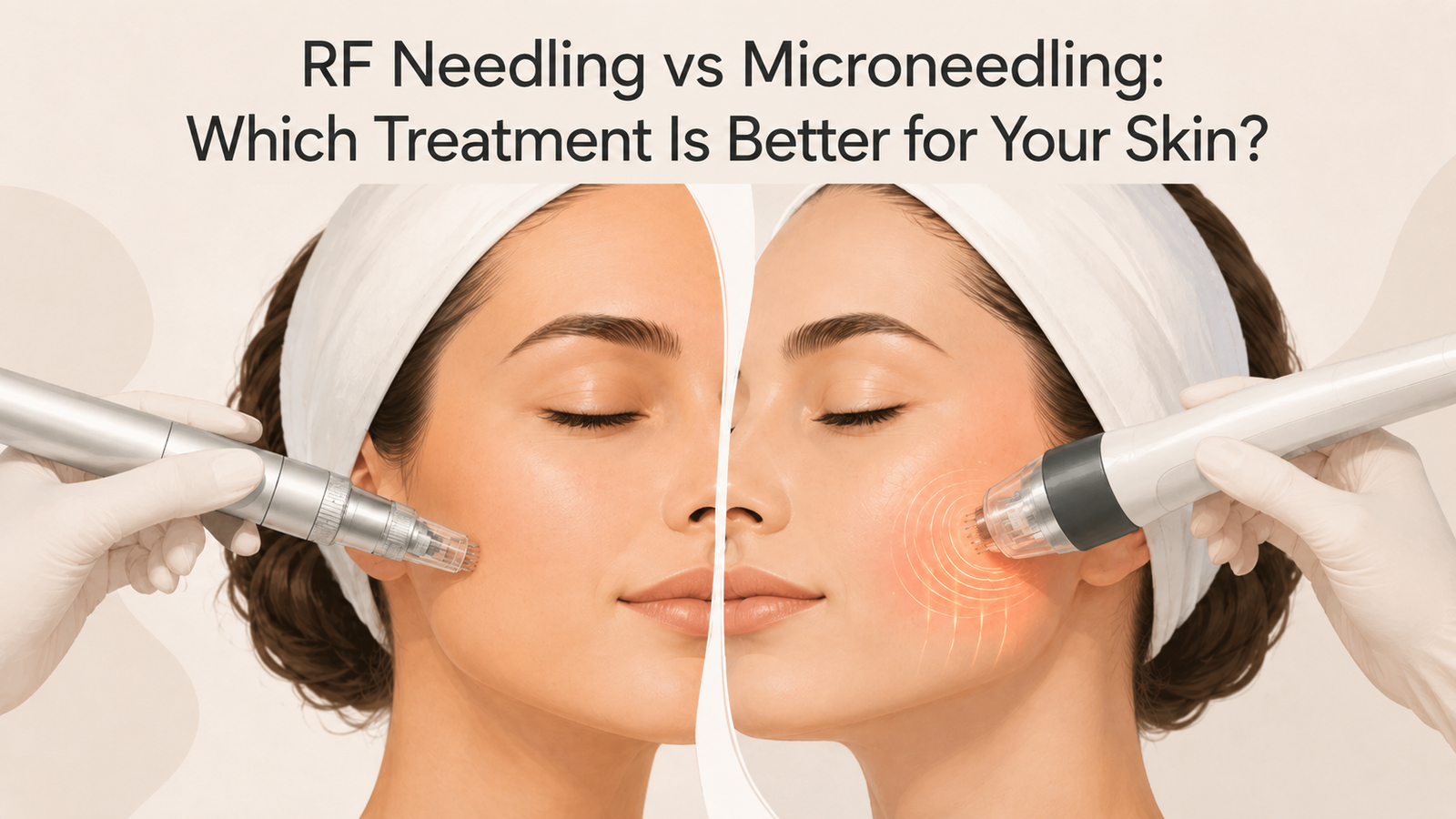
Choosing between RF needling vs microneedling can feel confusing because both treatments use tiny needles, both aim to improve skin texture, and both are often promoted for acne scars, fine lines, enlarged pores and collagen stimulation. But they are not the same treatment.
The simple difference is this: traditional microneedling creates controlled micro-injuries in the skin, while RF needling, also called RF microneedling or radiofrequency microneedling, adds heat energy beneath the skin for a deeper tightening effect.
That extra radiofrequency energy can make RF microneedling more suitable for certain concerns, such as mild skin laxity or deeper acne scarring. It can also make the treatment more expensive, more intensive and more dependent on the skill of the practitioner.
In this guide, you’ll learn how both treatments work, the real differences in results and downtime, who each treatment is best for, what risks to consider, and how to choose a safe clinic in the UK.
Quick Answer: RF Microneedling vs Microneedling
Microneedling is usually best for improving surface texture, mild acne scarring, pores, fine lines and overall skin quality. RF microneedling is usually better when you also want firmer skin, more collagen stimulation and support for mild sagging or deeper scarring.
Neither treatment is a one-session miracle. Most people need a course of treatments, and results build gradually because collagen remodelling takes time. Cleveland Clinic notes that microneedling usually requires multiple sessions and results may take three to six months to appear fully.
| Feature | Traditional Microneedling | RF Microneedling / RF Needling |
|---|---|---|
| Main method | Tiny needles create controlled micro-channels | Tiny needles plus radiofrequency heat |
| Best for | Texture, pores, mild scars, fine lines | Texture, scars, mild laxity, firmer skin |
| Depth of action | Mainly mechanical stimulation | Mechanical stimulation plus heat below the surface |
| Downtime | Usually redness and sensitivity for a few days | Often more swelling, warmth or redness depending on settings |
| Cost | Usually lower | Usually higher |
| Risk level | Lower when performed correctly | Higher if energy settings or depth are unsuitable |
| Best candidate | Early texture concerns or first-time collagen treatment | People needing stronger collagen support or tightening |
What Is Microneedling?
Microneedling is a minimally invasive skin treatment that uses very fine needles to create controlled micro-injuries in the skin. These tiny punctures trigger the skin’s natural repair process, encouraging collagen and elastin production. Collagen and elastin are the proteins that help skin look smoother, firmer and more resilient.
In plain English, microneedling tells your skin: “Repair this area.” Over time, that repair response can improve the appearance of acne scars, uneven texture, fine lines, enlarged pores and stretch marks. Cleveland Clinic describes microneedling as a procedure that uses thin needles to make small holes in the top layer of skin, stimulating healing and collagen production.
Microneedling is often chosen by people who want a collagen-boosting treatment without lasers or heat. It may be a good starting point if your main concern is dullness, mild acne scarring, rough texture or early signs of ageing.
Common microneedling benefits
Microneedling may help with:
- Mild to moderate acne scars
- Enlarged pores
- Fine lines
- Uneven skin texture
- Dull-looking skin
- Stretch marks
- Mild pigmentation irregularity
It is not ideal for every skin condition. People with active infections, active acne flare-ups, eczema, psoriasis, keloid scarring tendencies or certain medical conditions may not be suitable candidates. British College of Aesthetic Medicine guidance lists several contraindications, including active infection, abnormal scarring history, poorly controlled medical conditions, bleeding disorders, pregnancy or breastfeeding, and medicines that affect bleeding.
What Is RF Needling?
RF needling, more commonly called RF microneedling or radiofrequency microneedling, combines microneedling with radiofrequency energy. The needles enter the skin, then deliver controlled heat at selected depths.
This heat is the key difference. Instead of relying only on the body’s wound-healing response, RF microneedling also heats deeper layers of tissue to stimulate collagen remodelling and skin tightening. The FDA explains that RF microneedling devices use tiny microneedle electrodes to deliver radiofrequency energy into and under the skin, creating local heating.
Because RF energy reaches deeper than standard surface treatments, it can be useful for concerns that involve both texture and firmness. For example, someone with acne scars and early lower-face laxity may benefit more from RF microneedling than from standard microneedling alone.
Common RF needling benefits
RF needling benefits may include:
- Improved skin firmness
- Smoother acne scarring
- Better-looking skin texture
- Reduced appearance of fine lines
- Mild tightening around the jawline, cheeks or neck
- Support for crepey skin
- Collagen stimulation at deeper levels
However, RF microneedling should not be sold as a replacement for surgery. It may help mild to moderate laxity, but it will not produce the same result as a facelift, neck lift or surgical skin tightening.
RF Needling vs Microneedling: The Main Differences
The biggest difference in RF microneedling vs microneedling is not the needles. It is the energy.
Traditional microneedling is mechanical. RF microneedling is mechanical plus thermal. That means RF treatment uses both needle stimulation and heat.
1. Treatment depth
Traditional microneedling can be adjusted to different depths depending on the treatment area and concern. For example, shallow settings may be used for general glow and texture, while deeper settings may be used for acne scars.
RF microneedling also uses adjustable needle depth, but it adds energy delivery at targeted layers. This can make it more powerful, especially for skin firmness and deeper scar remodelling.
2. Results
Microneedling is often enough for people whose main concerns are texture, pores and early fine lines. RF microneedling may be a better choice when the skin also needs tightening or when scars are deeper and more stubborn.
A practical example:
If a 28-year-old has mild acne marks and enlarged pores, traditional microneedling may be a sensible first option. If a 42-year-old has acne scarring, mild jowling and loose texture around the cheeks, RF microneedling may offer a more complete treatment plan.
3. Downtime
Both treatments can cause redness, swelling, sensitivity and dryness. Standard microneedling often looks like a strong sunburn for one to three days, although this varies.
RF microneedling can involve more swelling or heat-related redness because energy is delivered below the skin. Some people look presentable within a few days, while others need longer, especially after deeper or more aggressive settings.
4. Comfort
Neither treatment should feel unbearable, especially when numbing cream is used. Standard microneedling often feels scratchy or prickly. RF microneedling may feel warmer, deeper or more intense because of the heat element.
If a clinic tells you RF microneedling is completely painless, be cautious. A realistic consultation should explain that comfort depends on the device, treatment depth, energy settings, area treated and your pain tolerance.
5. Cost
RF microneedling usually costs more than traditional microneedling because the equipment is more advanced, consumables are often more expensive, and the treatment requires more technical skill.
In the UK, prices vary widely by clinic, city, device, practitioner qualification and treatment area. London clinics often charge more than clinics in smaller towns, but price alone should never be the deciding factor. A cheap RF treatment performed badly can become far more expensive if complications need medical care.
Which Treatment Is Better for Your Skin Concern?
There is no universal winner in microneedling vs RF microneedling. The better option depends on your skin, goals, budget, tolerance for downtime and risk profile.
For acne scars
Both treatments can help acne scarring, but RF microneedling is often preferred for deeper, indented scars because it combines controlled injury with deeper collagen heating. Standard microneedling may still be helpful for mild acne scarring and overall texture.
For best results, acne scarring may need a combined plan. Some people benefit from microneedling, RF microneedling, chemical peels, subcision, laser or targeted skincare at different stages.
For fine lines
Microneedling can help soften fine lines by stimulating collagen. RF microneedling may be more suitable if the fine lines appear alongside loose or crepey skin.
For enlarged pores
Traditional microneedling is often a good starting point for enlarged pores and rough texture. RF microneedling may be considered if pores are linked with acne scars or loss of firmness.
For skin tightening
RF microneedling is usually the stronger option for mild tightening because RF energy creates heat below the surface. Cleveland Clinic explains that radiofrequency treatments use electromagnetic energy to generate heat, stimulating collagen, elastin and new skin cells.
However, RF is not a solution for severe sagging. If you have heavy jowls, significant loose neck skin or advanced laxity, a consultation with a medical aesthetic practitioner or plastic surgeon may be more appropriate.
For darker skin tones
Microneedling is often considered suitable for a wide range of skin tones because it does not rely on light or laser energy. Cleveland Clinic notes that microneedling does not carry the same skin-discolouration risk as some heat, light or laser-based treatments, which can make it useful for darker skin tones.
RF microneedling may also be suitable for many skin tones, but settings and practitioner experience matter. Incorrect energy levels, poor technique or inadequate aftercare can increase the risk of pigmentation changes.
Risks, Side Effects and UK Safety Considerations
Both treatments are skin-penetrating procedures. That means hygiene, training, device quality and aftercare are not optional details. They are central to safety.
Common side effects
After microneedling or RF microneedling, you may experience:
- Redness
- Swelling
- Warmth or tenderness
- Dryness or flaking
- Temporary tightness
- Mild pinpoint bleeding
- Sensitivity to skincare products
- Temporary breakouts
Less common risks include infection, bruising, pigmentation changes, scarring and flare-ups of cold sores. The FDA notes that microneedling devices can cause short-term or long-term side effects, including bleeding, bruising, redness, tightness, itching, peeling, infection and pigment changes.
RF microneedling has extra heat-related risks
Because RF microneedling uses heat, it brings risks that standard microneedling does not carry in the same way. In 2025, the FDA warned about reported serious complications from certain uses of RF microneedling devices, including burns, scarring, fat loss, disfigurement and nerve damage. The FDA also stated that RF microneedling is a medical procedure and should not be used at home.
The FDA is a US regulator, not a UK regulator, but the safety warning is still relevant for UK consumers because many device categories and treatment trends overlap internationally.
UK regulation is changing
In the UK, non-surgical cosmetic regulation has been a major concern because treatment quality can vary significantly. GOV.UK stated that the current aesthetics landscape has been fragmented and has not provided a robust system to protect the public from harm. It also noted that cosmetic procedures can cause serious injury if not performed correctly.
For patients, the practical takeaway is simple: do not choose a clinic based only on Instagram photos, discounts or influencer offers. Choose based on qualification, consultation quality, hygiene, device standards, complication support and realistic advice.
What to ask before booking
Before having either treatment, ask:
- Who will perform the treatment?
- What qualifications and training do they have?
- How many microneedling or RF microneedling treatments have they performed?
- What device will be used?
- Is a new sterile needle cartridge used each time?
- What complications can happen?
- Who provides aftercare if something goes wrong?
- Am I suitable based on my skin type, medical history and current skincare?
- How many sessions will I likely need?
- What results are realistic for my skin?
NHS guidance recommends booking a consultation with the person who will carry out the cosmetic procedure, asking about their qualifications, complications, aftercare, costs and what to do if something goes wrong. It also advises avoiding group treatments, alcohol-related treatment events, voucher deals and mobile services in private homes or hotels.
How to Choose Between RF Needling and Microneedling
A good treatment decision starts with your main concern.
Choose traditional microneedling if you want a lower-intensity collagen treatment for texture, pores, mild scarring, dullness or early fine lines. It is often a sensible first step if you are new to professional skin treatments.
Choose RF microneedling if you want collagen stimulation plus mild tightening, or if your acne scarring is deeper and you are comfortable with a more advanced treatment, higher cost and potentially longer downtime.
You may not need RF if your skin is already firm and your concern is mainly surface texture. Equally, you may be disappointed with standard microneedling if you expect lifting, tightening or major scar revision.
The best clinics will not push one treatment for everyone. They will assess your skin, explain options, discuss risks clearly and tell you when another treatment may be more suitable.
Suggested Internal Linking Opportunities
To strengthen topical authority and improve user journey, add internal links from this article to:
- A guide on microneedling aftercare
- A service page for RF microneedling treatment
- A service page for traditional microneedling
- A guide on acne scar treatment options
- A blog on how many microneedling sessions you need
- A guide comparing chemical peels vs microneedling
- A clinic page explaining skin consultation and treatment planning
FAQs About RF Needling vs Microneedling
Is RF microneedling better than microneedling?
RF microneedling is not automatically better. It is stronger for certain concerns, especially mild skin laxity, deeper acne scars and collagen tightening. Traditional microneedling may be better if your main concerns are texture, pores, mild scars or if you want a simpler treatment with lower cost and less intensity.
Does RF microneedling hurt more than normal microneedling?
RF microneedling can feel more intense because it adds heat beneath the skin. Numbing cream usually makes the treatment manageable, but you may feel warmth, pressure or sharp heat pulses. Standard microneedling often feels more like scratching, prickling or vibration.
How many sessions do I need?
Most people need a course of treatments. Standard microneedling may involve three to six sessions, while RF microneedling often involves three or more sessions depending on the concern. Acne scars, stretch marks and laxity usually need more sessions than general skin refreshment.
Is RF microneedling safe?
RF microneedling can be safe when performed by a properly trained practitioner using an appropriate device and correct settings. The main concern is that it carries extra heat-related risks, including burns, scarring, pigmentation changes and, rarely, fat loss or nerve injury. Always choose a qualified provider and avoid at-home RF microneedling devices.
Can I do microneedling at home?
At-home rollers or pens are not the same as professional microneedling. They usually work at shallower depths and carry infection or injury risks if used incorrectly. Professional treatment is safer for acne scars, deeper collagen stimulation and medical-grade results because the practitioner can assess your skin, use sterile equipment and manage complications.
Conclusion: Which One Should You Choose?
When comparing RF needling vs microneedling, the right choice depends on what your skin actually needs.
If your main goal is smoother texture, brighter skin, smaller-looking pores or mild acne scarring, traditional microneedling may be enough. If you want deeper collagen stimulation, mild tightening or stronger support for acne scars, RF microneedling may be more suitable.
The most important step is not choosing the trendiest treatment. It is choosing the right treatment, performed by the right practitioner, at the right settings for your skin.
Before booking, arrange a proper consultation, ask about qualifications and aftercare, and make sure the clinic gives you realistic expectations. For your next step, read a microneedling aftercare guide or speak with a qualified skin professional who can assess your skin in person.